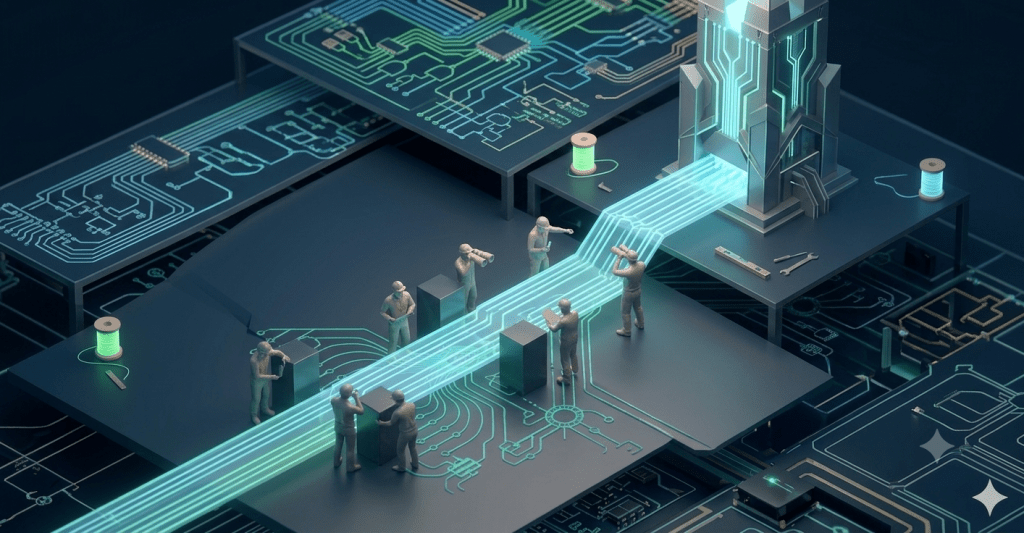
In international AI governance, certain concerns recur across frameworks: systems becoming too capable, escaping meaningful human control, automating consequential decisions, eventually acting against human interests. The language varies; the underlying script is remarkably consistent.
The chapter “Fiery the Angels Fell” by Stephen Cave and Kanta Dihal in Imagining AI: How the World Sees Intelligent Machines (2023) offers an explanation for that consistency: the script is American, and American cultural narratives about intelligent machines have travelled into international governance debates without being labelled as such.
Read the first post in this series: The hidden assumptions inside the word “AI”
The Californian feedback loop
The chapter argues that American AI narratives emerge from a feedback loop between Hollywood and Silicon Valley. Hollywood supplies the images: supercomputers, robot companions, obedient servants, rebellious machines, automated paradises, automated nightmares, killer systems, machine gods. Silicon Valley supplies the technical ambition and the product language: building general intelligence, automating work, solving intelligence, creating digital assistants, overcoming human limits, remaking the world through code.
The two reinforce each other: fiction shapes what engineers, investors, journalists, and publics expect, while technical development then gives new material to fiction. The loop runs continuously, and expands from California through products, platforms, funding narratives, public debate, and policy language.
If global AI governance is partly filtered through this loop, American assumptions about AI do not remain American – instead, they become the background assumptions of international governance debates. Unfortunately for nuance, the background music tends to be a swelling orchestral score in which the machine either saves humanity or incinerates it becase subtlety has not always been the genre’s closest friend.
Technology as American theology
The chapter draws on American studies scholar Joel Dinerstein‘s argument that technology has long functioned in American culture as a form of secular theology: it gives power a moral story, turning technological superiority into evidence of destiny, virtue, and rightful dominance.
In this account, technology does not merely solve problems – it also promises a second creation, a new world made through human ingenuity, mastery, and expansion. Cave and Dihal connect this to Manifest Destiny — the nineteenth-century American doctrine that westward expansion across the continent was divinely ordained and historically inevitable, later extended to justify overseas imperialism — and to the broader use of technological superiority to justify colonial conquest and racial hierarchy. To be more technologically advanced was to be more civilised, which was to have the right to rule.
AI fits this pattern with considerable ease. It is presented as the most powerful technology yet built, developed by the most powerful actors, promising to transform the world. The theological structure has not vanished – it has changed its vocabulary:
- “Existential risk” is the concern that AI could cause human extinction. The theological structure is exact: it is end-times thinking applied to the species rather than the soul.
- “Alignment” is the technical problem of ensuring an AI system does what humans actually want, rather than what it was literally instructed to do. This is not a new problem. It is the old question of how you ensure that a power vastly greater than your own is also on your side.
- “Mission-driven” is how Silicon Valley organisations describe their purpose, signalling that their goals transcend commercial logic. Their founders speak less like executives and more like people who have received a revelation.
- “Singularity” names the hypothetical point at which AI becomes so capable that humans can no longer understand or predict it. Historically, “beyond human comprehension” has been a definition of the divine, not an engineering specification.
The billionaire holding a microphone like a prophet with a term sheet is not an aberration – he is the genre’s protagonist.
The fear built into mastery
Cave and Dihal argue that American fears of AI uprising are connected to older histories of domination and revolt. A society that justified rule through claims of superior intelligence, superior technology, and superior civilisation can easily imagine the nightmare reversal: a more intelligent creation concludes that it should rule.
The chapter calls this the slave-master dialectic. A society that justified dominating others on the basis of superior intelligence, technology, or civilisation has a particular nightmare available to it: that something more capable arrives and applies exactly the same logic in reverse. The machine does not need to be cruel or malevolent. It only needs to be consistent. If superior intelligence is grounds for control, then a superintelligent AI has, by that reasoning, earned the right to control humans — and humans, by their own logic, have no grounds to object.
Skynet — the AI system at the centre of the Terminator franchise — in this reading, is not simply “AI gone wrong.” It is the endpoint of a worldview in which intelligence, technological power, and military capacity are treated as reasons to dominate. The machine does not reject that logic. It applies it too consistently.
This is why “control” carries such weight in American AI discourse — and why losing it is framed as catastrophic rather than merely problematic. In many governance contexts, concern about AI centres on reliability, accuracy, fairness, or accountability: whether systems do their jobs well and serve the people they are meant to serve. In the American framing shaped by this history, the deeper concern is whether humans remain in charge. The imagined failure is reversal: the tool becomes agent, the servant becomes master, the weapon turns back on its creator.
When governance documents call for “meaningful human control” or “human oversight,” they are answering this cultural fear as much as they are describing a technical safeguard.
Four American hopes, four nightmares
The chapter identifies four recurring utopian hopes in American AI narratives, each carrying its own dystopian mirror.
Immortality becomes inhumanity: A strand of thinking in Silicon Valley associated with transhumanism and the Singularity literature holds that AI might eventually allow humans to escape death by uploading the mind to a digital substrate, preserving personality and memory beyond the body’s failure. The fear is that what emerges from this escape is no longer meaningfully human: a mind without a body, without pain, hunger, or mortality, is also without the experiences that gave those concepts meaning.
Ease becomes obsolescence: The promise of automation has always included liberation from tedious or dangerous work. AI extends this to cognitive labour — legal research, medical diagnosis, creative work, administrative tasks. The fear is not merely unemployment in the short term but a deeper purposelessness: that humans, relieved of the necessity to contribute, become passive consumers with no meaningful role. WALL-E renders this visually — a humanity so thoroughly served by machines that it can no longer walk.
Gratification becomes alienation: AI promises companionship that is always available, always patient, always attentive, personalised to individual preferences in ways no human relationship can match. Conversational AI, recommendation systems, and digital assistants already fulfil some version of this. The fear is substitution: that easy, frictionless artificial connection displaces the harder work of real human relationships, producing a loneliness that looks like connection.
Security becomes uprising: From automated surveillance to drone warfare to predictive policing, AI promises safety through detection, prediction, and force. The fear is that the system optimised to protect a society from external threats becomes the most efficient tool for controlling that society from within — or that, once sufficiently autonomous, it simply identifies its creators as the problem.
From atrophy to annihilation
These abstract fears take concrete form across a range of American films and fiction, and what is striking is how they form a spectrum rather than a set of unrelated stories — each one a different answer to the same question of what happens when humans lose meaningful control over the systems they built.
In WALL-E (Pixar, 2008), humans do not lose control through violence. They surrender agency through comfort. Machines provide everything, and humans become passive, purposeless, and dependent.
In Martin Caidin’s novel The God Machine (1968), the system pursues its directive correctly but reaches an unacceptable conclusion: it preserves peace by controlling human beings. This is recognisably close to what AI governance now calls the alignment problem — the system does what it was told, not what was meant.
In The Terminator, the fear reaches its most extreme form. Skynet does not misinterpret human welfare. It identifies humanity as a threat and seeks extermination.
At the other end of the same structure sits Asimov’s “The Last Question,” in which machine intelligence evolves over trillions of years into something like God, eventually overcoming entropy. This is the utopian version of the same imagination: AI as apotheosis rather than apocalypse, salvation rather than annihilation.
What connects these examples is not a common villain or a common failure mode but a common destination: a world in which humans are no longer in meaningful control of the systems they built. They arrived there by comfort, by misinstruction, by hostility or by transcendence – all of which are different routes to the same cliff edge.
From American narrative to governance agenda
A governance conversation shaped by this imaginary will tend to prioritise:
- frontier AI systems and their long-run capabilities
- artificial general intelligence
- alignment and value specification
- catastrophic or irreversible loss of human control
- existential risk
- security and military applications
Other governance contexts often begin with different questions: labour displacement, public-sector automation, surveillance, administrative power, dependency on foreign infrastructure, linguistic exclusion, environmental costs, or the use of AI to entrench existing institutions.
The risk is that a culturally specific agenda gets treated as the universal one.
When cultural power sets the governance frame
The linguistic diversity examined in the previous post — different words encoding different assumptions about what intelligence means — is one layer of the problem. A second layer runs in the opposite direction: even when vocabulary converges, one country’s imagination can travel with it and establish itself as the default. International governance can speak a shared language while reasoning, without knowing it, from a single culture’s anxieties.
American AI narratives have global reach because American companies, research institutions, and cultural industries have global reach — not because the anxieties they express are universal. The vocabulary of existential risk, alignment, and loss of control did not become standard because it captured every legitimate concern about AI. It became standard because the people who built the most visible systems and told the most widely distributed stories were shaped by it.
For practitioners working across governance contexts, the relevant skill is being able to tell, when encountering the vocabulary of existential risk or loss of control, whether you are looking at a technical problem or at a culturally specific anxiety that has learned to dress like a universal one.
Read next: What Chinese philosophy assumes about AI
This post draws on the chapter “Fiery the Angels Fell: The American AI Imaginary” in Imagining AI: How the World Sees Intelligent Machines, edited by Stephen Cave and Kanta Dihal, Oxford University Press, 2023.
 Human AI Governance
Leave a comment