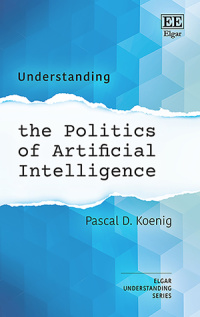
Pascal D. Koenig’s Understanding the Politics of Artificial Intelligence is a compact handbook for making sense of AI as a political phenomenon. Its central question is simple but useful: in what ways is AI political, and when does it become a political issue?
The book starts from a distinction between two meanings of politics. In the narrower sense, AI becomes political when governments regulate it, use it in public administration, or debate it through formal political institutions. In the broader sense, AI is political when it shapes social relations, distributes power, structures choices, or changes the conditions under which people act. This wider view matters because many AI systems affect society without ever appearing as “politics” in the familiar parliamentary or party-political sense.
Koenig then builds out the argument across several layers. He first clarifies what counts as AI and why AI systems need to be understood in context rather than treated as isolated technical artefacts. The book is especially useful on the idea of AI systems as parts of larger socio-technical arrangements, where data, design choices, organisational settings, user behaviour, regulation, and power relations all shape what the system does in practice.
A major theme is that data, algorithms, and AI systems are never neutral. The book explains how values enter through apparently technical decisions: what data is collected, what is left out, what outcome is predicted, what counts as good performance, and how errors are weighted. This makes the politics of AI partly a politics of measurement, classification, and quantification. Rather inconveniently for anyone hoping for clean technical separation, the “technical” choices keep leaking values all over the floor.
The book also examines AI as a mode of social ordering. Koenig discusses how AI can support governance with AI, where systems inform human decision-making, and governance by AI, where systems more directly steer behaviour. This distinction is particularly useful for thinking about democracy, because optimisation is not the same as political judgement. AI systems can help pursue predefined goals, but they cannot decide what a society should value in the first place without smuggling in someone’s assumptions about what counts as better.
The later chapters widen the lens. Koenig looks at AI narratives in popular culture and media reporting, public perceptions of AI, party competition, politicisation, geopolitics, and different regulatory approaches. This makes the book useful as a structured overview rather than a single-argument polemic. It shows how AI becomes political through design, use, public interpretation, institutional conflict, international competition, and regulation.
Why you should read this
This is worth reading if you want a clear, systematic entry point into the politics of AI without having to assemble the whole map yourself from scattered papers, policy reports, and slightly overheated conference panels.
Its value is that it separates several questions that are often blurred together: whether AI systems embody values, whether their social effects are political, whether AI has become salient in public debate, whether political actors compete over it, and how different regulatory systems respond. For anyone working around AI governance, public administration, technology policy, or organisational adoption, that separation is useful. It gives you a way to locate a problem before trying to argue about it.
It is also useful because it keeps AI in historical and institutional context. The book does not treat AI as an unprecedented rupture in every respect. It shows both what is new and what continues older patterns around technology, quantification, bureaucracy, markets, public opinion, and state power. That makes it a good corrective to AI discussions that behave as if history began with ChatGPT, which is convenient but not especially dignified.
 Human AI Governance
Leave a comment