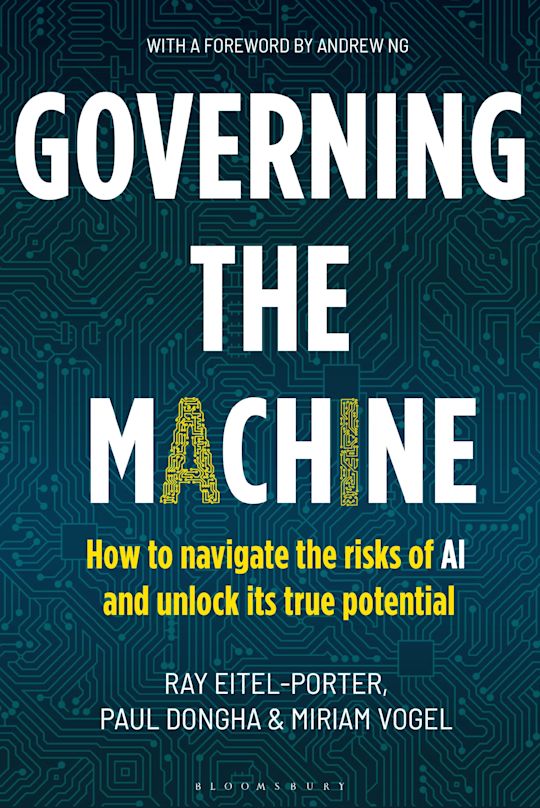
Governing the Machine approaches AI from the perspective of control, coordination, and institutional responsibility. Rather than focusing on technical capability, it centres on a more practical question: how do organisations and governments manage systems that are increasingly complex, adaptive, and difficult to fully specify in advance?
The book treats AI systems as part of broader organisational and economic structures rather than as standalone tools. This shifts attention from model performance to questions of deployment, oversight, and accountability. In this framing, the challenge is not only what the system can do, but how decisions about its use are made, who is responsible for outcomes, and how risks are identified and managed over time.
A recurring theme is the gap between rapid technological development and slower-moving governance structures. AI systems can be introduced into workflows quickly, but the mechanisms for monitoring, auditing, and correcting them often lag behind. This creates situations where systems are relied on operationally before their behaviour is fully understood in context.
The book also emphasises that governance is not a single intervention but an ongoing process. It involves design choices, procurement decisions, organisational routines, regulatory frameworks, and feedback loops that operate after deployment. This broader view makes governance less about compliance at a fixed point and more about maintaining control under changing conditions.
Risk is treated in a similarly operational way. Rather than focusing only on extreme or hypothetical scenarios, the book looks at how risks emerge through everyday use: misaligned incentives, overreliance on automated outputs, unclear accountability, and weak mechanisms for escalation when systems behave unexpectedly. These are not failures of the technology alone, but of the systems around it.
Across its chapters, the book builds a picture of AI governance as a coordination problem. It reads as a practical guide to how organisations can approach risk, oversight, and accountability in a systematic way, rather than as a single, strongly argued position.
Why you should read this
This is worth reading if you are less interested in abstract debates about AI risk and more interested in how organisations translate governance concerns into processes, roles, and decision structures.
Its strength is that it keeps attention on the operational layer, where most problems occur. It shifts the focus from “what could go wrong in theory” to “what tends to go wrong in practice when systems are deployed, used, and managed over time.” That makes it particularly relevant for work in public administration, organisational adoption, and policy implementation.
It is also useful if you are thinking about oversight. The book implicitly challenges the idea that oversight can be reduced to a single human decision point. Instead, it shows how control is distributed across processes, roles, and institutional arrangements, which aligns more closely with how AI systems are actually used.
One limitation to be aware of, depending on your expectations, is that the book stays relatively close to governance and risk management concerns. If you are looking for a deeper treatment of the underlying technical systems or more speculative future scenarios, this is not where it spends its energy. Its contribution is narrower but more grounded.
 Human AI Governance
Leave a comment